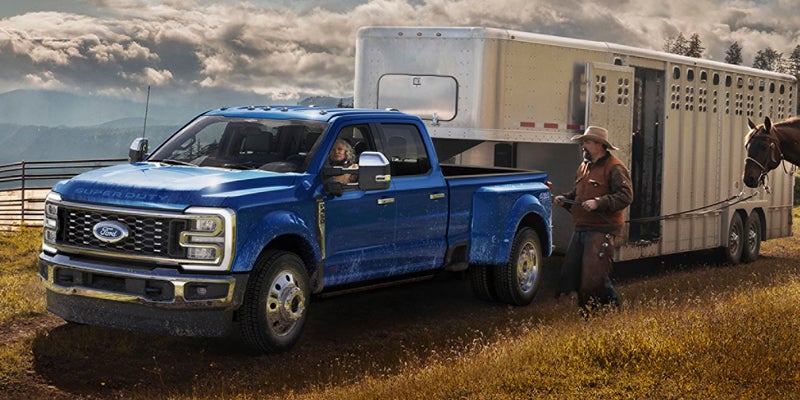
The 2027 Ford F-250 Super Duty offers two powerful engine choices: a standard 7.3L V8 gasoline engine and an available 6.7L High-Output Power Stroke turbo-diesel. The gasoline engine delivers strong capability with generally simpler maintenance requirements, while the diesel provides substantially more torque for demanding towing and hauling. For drivers comparing the 2027 Ford F-250 gas vs. diesel in Sumner, WA, the right engine depends on how often you tow, the weight of your equipment, your driving habits, and long-term ownership costs.
Shop New Ford Super Duty Trucks Schedule a Test Drive
2027 Ford F-250 Gas vs. Diesel: Key Differences
The biggest difference between the 2027 F-250 gas and diesel engines is torque and maximum towing capability. The 7.3L gas V8 offers substantial power for everyday work and recreational hauling, while the High-Output Power Stroke diesel provides additional low-RPM torque for regularly pulling heavier trailers.
| Specification | 7.3L V8 Gas | 6.7L High-Output Diesel |
|---|---|---|
| Availability | Standard | Available |
| Horsepower | 420 hp | 500 hp |
| Torque | 445 lb.-ft. | 1,200 lb.-ft. |
| Transmission | 10-speed automatic | 10-speed automatic |
| Maximum Conventional Towing | 18,200 lbs. | 22,000 lbs. |
| Maximum Gooseneck Towing | 19,500 lbs. | 23,000 lbs. |
| Fuel Type | Gasoline | Diesel |
| Maintenance Considerations | Generally simpler engine service | Additional diesel-specific maintenance and emissions equipment |
| Primary Advantage | Versatility and ownership simplicity | High torque and heavier towing capability |
Maximum towing ratings are for specific properly equipped 2027 F-250 configurations and are not available on every truck. Ratings depend on cab, drivetrain, axle ratio, equipment, and other factors. Horsepower and torque are independent ratings.
What's New for the 2027 Ford F-250 Engines?
Ford has simplified the Super Duty engine lineup for 2027. The 7.3L V8 gasoline engine is now standard on F-250 models, replacing the previous standard 6.8L V8.
The available diesel option has also changed. Instead of offering separate standard-output and high-output 6.7L Power Stroke engines, the 2027 F-250 features the High-Output version as its available diesel powertrain.
This gives shoppers two distinct options: a naturally aspirated gasoline V8 designed for versatile heavy-duty work or a turbocharged diesel V8 emphasizing high torque and maximum towing performance.
Engine Performance: 7.3L Gas V8 vs. 6.7L Power Stroke Diesel
2027 F-250 7.3L V8 Gas Engine
The standard 7.3L gasoline V8 produces 420 horsepower and 445 lb.-ft. of torque. Its naturally aspirated design delivers strong performance without requiring a turbocharger.
For contractors working around Sumner and Auburn, the gas-powered F-250 offers substantial capability for transporting materials, carrying tools, and towing properly matched equipment trailers.
Drivers who primarily use their trucks for commuting, occasional hauling, and weekend towing may find the 7.3L V8 provides the performance they need without the additional complexity of diesel-specific engine and emissions systems.
2027 F-250 6.7L High-Output Power Stroke Diesel
The available 6.7L High-Output Power Stroke turbo-diesel produces 500 horsepower and an impressive 1,200 lb.-ft. of torque.
That substantial torque output is especially useful when pulling heavy trailers, accelerating with substantial loads, or maintaining performance on inclines.
For drivers regularly towing construction equipment, large recreational trailers, or other heavy loads through the Cascade foothills near Enumclaw, the diesel's torque can provide a meaningful advantage.
Both engines are paired with a TorqShift 10-speed automatic transmission designed to manage power delivery across different driving and towing conditions.
Which 2027 Ford F-250 Has More Towing Capacity?
The diesel-powered 2027 F-250 offers greater maximum towing capacity. When properly equipped, it can tow up to 22,000 pounds with a conventional trailer or 23,000 pounds using a gooseneck configuration.
The gas-powered F-250 is also highly capable, offering maximum conventional towing of 18,200 pounds and gooseneck towing of up to 19,500 pounds in qualifying configurations.
However, choosing the correct truck requires more than comparing maximum ratings. Drivers must consider the loaded trailer weight, hitch type, axle ratio, cab configuration, drivetrain, and available payload.
When Is the Gas F-250 Enough for Towing?
A gas-powered F-250 may be appropriate for drivers who occasionally tow utility trailers, equipment, recreational vehicles, or work supplies that fall comfortably within the truck's specific ratings.
For example, a contractor in Bonney Lake transporting tools and a loaded utility trailer to a job site in Sumner may not need the diesel's additional torque if the combined load is within the gas truck's capabilities.
Similarly, drivers who tow a travel trailer only a few times throughout the year may find the gas engine sufficient, depending on the trailer's loaded weight and the truck's configuration.
When Does the Diesel F-250 Make More Sense?
The diesel becomes particularly appealing when towing is a frequent part of your routine.
Drivers regularly hauling heavy equipment, pulling larger trailers, or traveling through hilly terrain may appreciate the diesel's low-RPM torque and additional available towing capacity.
For example, a business transporting heavy machinery between Auburn and Enumclaw may benefit from the High-Output Power Stroke's capability, especially when operating near the upper towing limits of properly configured trucks.
Remember that trailer tongue weight or gooseneck pin weight also counts against the truck's payload capacity. A higher tow rating does not automatically mean every trailer can be safely carried by every F-250.
Payload Capacity: Does Gas or Diesel Carry More Weight?
Payload refers to the weight a truck can carry, including passengers, tools, equipment, cargo, and trailer tongue or pin weight.
Although the diesel offers greater towing potential, that does not automatically mean it provides greater payload capacity.
Diesel engines and their associated equipment are generally heavier than comparable gasoline powertrains. As a result, a gas-powered F-250 may offer more available payload than a similarly configured diesel model.
This difference can matter for construction crews or businesses that routinely carry heavy materials directly in the truck bed.
For example, a driver transporting tools, landscaping materials, and job-site supplies around Sumner may benefit more from available payload capacity than maximum towing performance.
Because payload ratings change with equipment and configuration, shoppers should check the individual truck's Tire and Loading Information label and Safety Compliance Certification Label rather than relying on a general maximum rating.
Fuel Economy: Is the F-250 Diesel More Efficient Than Gas?
Fuel efficiency is another important consideration when comparing gas and diesel Super Duty trucks.
Diesel engines can offer fuel-efficiency advantages under certain operating conditions, particularly during sustained highway driving and heavy towing. However, actual fuel consumption varies based on trailer weight, driving conditions, gearing, and driving habits.
Heavy-duty trucks such as the F-250 are generally not required to display EPA fuel economy estimates, so shoppers should be cautious about comparing unofficial MPG claims.
When evaluating fuel costs, consider:
- Annual mileage: Drivers covering substantial distances may place greater importance on fuel consumption.
- Fuel prices: Gasoline and diesel prices vary, affecting the cost of each mile driven.
- Towing frequency: Heavy trailers increase fuel consumption regardless of engine type.
- Driving conditions: Highway travel, stop-and-go traffic, and steep grades can affect efficiency differently.
- Diesel Exhaust Fluid: Diesel models require DEF as part of their emissions-control system, adding another operating expense.
For someone commuting between Bonney Lake and Sumner without regularly towing, the gasoline engine's lower expected purchase and maintenance costs may outweigh a potential diesel fuel-efficiency advantage.
For drivers covering substantial highway mileage while transporting heavy loads, the diesel may be worth considering as part of a complete ownership-cost comparison.
Maintenance Costs: Is a Gas F-250 Cheaper to Maintain Than a Diesel?
The gasoline-powered F-250 generally has simpler routine maintenance requirements because it does not use diesel-specific fuel filtration and exhaust aftertreatment equipment.
Gas Engine Maintenance
Routine maintenance for the 7.3L gas V8 includes engine oil and filter changes, air filter inspections, spark plug replacement at the appropriate interval, and other manufacturer-recommended services.
This relatively straightforward maintenance may appeal to drivers who use their trucks for occasional towing, short commutes, and general transportation.
Diesel Engine Maintenance
The 6.7L Power Stroke requires additional attention to components associated with its diesel fuel and emissions systems.
Maintenance and operating considerations include:
- Diesel engine oil and filter service.
- Diesel fuel filter replacement.
- Diesel Exhaust Fluid replenishment.
- Proper operation of the diesel particulate filter and regeneration system.
- Maintenance according to operating conditions and Ford's recommended schedules.
Diesel particulate filter regeneration is particularly relevant for drivers who frequently make short trips. Certain driving conditions may not allow active regeneration to complete normally, making it important to follow the vehicle's instructions and recommended maintenance practices.
Neither engine's long-term ownership cost can be determined from maintenance requirements alone. Purchase cost, repairs, fuel consumption, towing demands, and annual mileage all matter.
Everyday Driving: Which F-250 Is Better for Commuting?
The F-250 Super Duty is designed for substantial work and towing capability, but many owners also use their trucks for everyday transportation.
For commuting along Highway 410 or traveling between Sumner and Auburn, the gasoline V8 offers strong acceleration and a powertrain suited to varied driving conditions.
The diesel also delivers substantial performance, particularly when additional torque is needed. However, drivers who primarily make short, unloaded trips may not take full advantage of its heavy-towing capabilities.
Both engines are available across a range of F-250 configurations, with cabin comfort, technology, and convenience features depending primarily on trim level and selected equipment.
Drivers should also consider the truck's overall dimensions, parking requirements, bed length, and whether available four-wheel drive would benefit their daily activities.
Which 2027 Ford F-250 Engine Fits Your Needs?
Choose the 7.3L V8 gasoline engine if:
- You primarily use your truck for everyday transportation and work.
- You tow occasionally rather than carrying heavy trailers every day.
- You want generally simpler engine maintenance.
- You frequently carry tools or materials and want to compare available payload ratings.
- You prefer to avoid the additional purchase cost of the available diesel engine.
Consider the 6.7L High-Output Power Stroke diesel if:
- You regularly tow heavy trailers or machinery.
- You need the F-250's highest available towing capability.
- You frequently travel through hilly terrain with substantial loads.
- You value strong low-RPM torque for demanding towing.
- Your annual mileage and operating requirements justify evaluating the diesel's additional ownership costs.
For contractors, recreational vehicle owners, and drivers throughout Sumner, Bonney Lake, Enumclaw, and Auburn, selecting the right engine starts with identifying the weight and frequency of your actual towing and hauling needs.
Frequently Asked Questions About the 2027 F-250 Gas vs. Diesel
Is the 7.3L gas engine standard on the 2027 Ford F-250?
Yes. The 7.3L V8 gasoline engine is now standard on the 2027 Ford F-250. The available diesel option is the 6.7L High-Output Power Stroke V8 turbo-diesel.
How much horsepower does the 2027 F-250 diesel have?
The 2027 F-250's available 6.7L High-Output Power Stroke produces 500 horsepower and 1,200 lb.-ft. of torque. The standard 7.3L gas V8 produces 420 horsepower and 445 lb.-ft. of torque.
How much can the 2027 Ford F-250 tow with the gas engine?
A properly equipped 2027 F-250 with the 7.3L gas V8 can tow up to 18,200 pounds conventionally or up to 19,500 pounds with a gooseneck trailer. Specific ratings vary by equipment and configuration.
Is the Ford F-250 diesel worth it if I don't tow often?
Not necessarily. The diesel's additional torque and towing capability are valuable for demanding work, but drivers who rarely tow heavy loads may find the standard gas V8 better suited to their needs and ownership budget.
Does a diesel F-250 have more payload than a gas F-250?
Not automatically. Because diesel powertrains generally weigh more, similarly configured gasoline trucks may provide greater available payload. Compare the specific vehicles' ratings before choosing an engine.
Which F-250 engine is better for towing a large travel trailer?
Both engines can tow compatible travel trailers, but the diesel offers greater maximum towing capacity and substantially more low-RPM torque. The correct choice depends on the trailer's loaded weight, tongue or pin weight, towing frequency, and the truck's individual ratings.
Compare 2027 Ford F-250 Gas and Diesel Trucks at Sunset Ford of Sumner
The 2027 Ford F-250 provides two distinct engine choices for drivers who need heavy-duty capability. The standard 7.3L V8 gas engine offers substantial performance and generally simpler maintenance, while the available 6.7L High-Output Power Stroke diesel delivers additional torque and towing capacity for more demanding applications.
At Sunset Ford of Sumner, located at 6616 166th Avenue East in Sumner, WA, our team can help drivers from Bonney Lake, Enumclaw, Auburn, and surrounding communities compare available gas and diesel Super Duty trucks.
We can help you review engine options, cab configurations, towing equipment, and payload ratings to identify a truck that fits your work and recreational needs.
Qualifying purchases may also include Sunset Exclusives, such as Oil Changes for Life and Warranty Protection for Life, subject to applicable program terms and eligibility requirements.
Explore our new Ford Super Duty inventory and visit Sunset Ford of Sumner to compare available F-250 configurations in person.
Shop New Ford F-250 Trucks Schedule a Test Drive
Vehicle specifications, engine availability, towing capacity, payload ratings, and equipment vary by configuration. Maximum towing figures require properly equipped vehicles and are not applicable to all F-250 models. Always consult the vehicle's certification labels, owner's manual, and Ford's current towing guide before towing or hauling. Dealer inventory and program eligibility are subject to change.